
June Quarter 2026: Share markets bounce back as oil prices fall

Global share markets recovered from their March quarter decline, encouraged by some normalisation in the oil price.
Beneficiaries of Artificial Intelligence led equity markets higher over the quarter.
Australian bond yields declined, despite higher cash interest rates.

INTERNATIONAL EQUITITES:
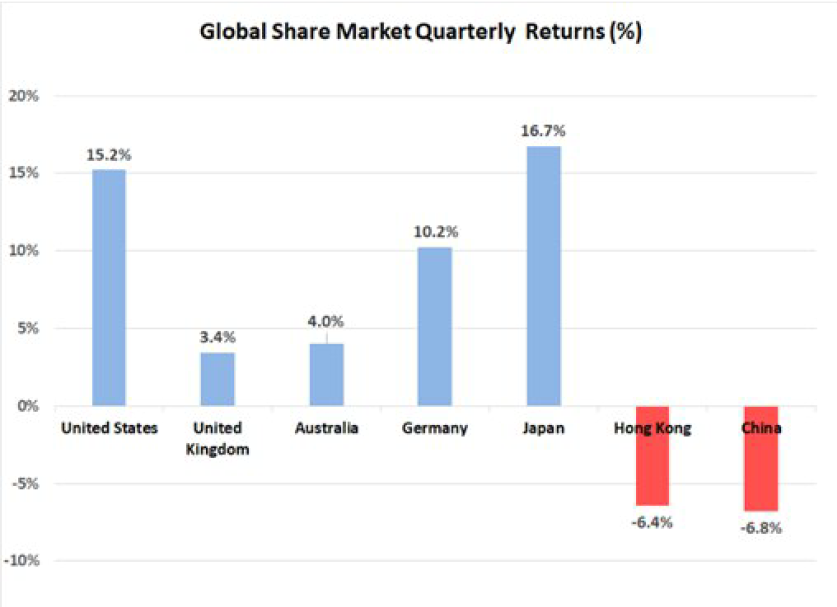
Despite a continuation of military conflict in the Middle East and the Strait of Hormuz being closed for much of the quarter, global share market sentiment returned to being strongly positive over the June quarter. Progress towards an interim peace deal that was reached late in the quarter saw the oil price progressively decline. The WTI Crude Oil price dropped from $US 101.40 per barrel at the end of March to $US 69.50 by the end of June. As a result, global inflationary concerns subsided, which contributed to the turnaround in sentiment on share markets. As has been the case for much of the past 2 years, it was U.S. technology stocks that made the strongest contribution to share market gains. Overall, the S&P 500 Index was 15.2% higher for the quarter, with the technology sector within the U.S. market gaining 26.9%. Highlighting the wide disparity in performance across stocks and sectors, the more defensively positioned U.S consumer staples and utilities sectors finished in slightly negative territory for the quarter.
Outside of the U.S., Japan also made a significant contribution and was the best-performing major developed market during the quarter, with the MSCI Japan Index recording a gain of 16.7%. Japanese companies linked to technology, automation and advanced manufacturing continued to benefit from strong global capital expenditure trends.
Performance across emerging markets was mixed, with exceptionally strong gains being recorded by the semi-conductor and chip manufacturers in South Korea and Taiwan in response to ongoing high rates of Artificial Intelligence related expenditures. These two markets rallied 89.7% and 48.3% respectively. South Korea has experienced an astounding 260% gain over the past 12 months. However, China declined by 6.8% and Hong Kong fell 6.4% in the June quarter, as investors remained cautious regarding the pace of Chinese economic growth and the outlook for domestic demand.
The rotation away from defensive sectors towards technology resulted in some relative weakness in global listed infrastructure stocks last quarter, with gains in the asset class restricted to 2.0%. There was more support for property, however, with global listed property returning 8.8%. Gains in Australian listed property were even stronger at 13.5%, with lower bond yields and the attraction of Goodman Group’s (up 22.5%) data centre strategies boosting support for the sector.
AUSTRALIAN EQUITITES:

The Australian share market significantly underperformed the global average over the June quarter, with the S&P ASX 200 Index rise restricted to just 4.0%. Energy was the weakest performer, with the fall in global oil prices triggering a negative 16.5% return for the sector. It was another difficult period for healthcare stocks, with both CSL (down 18.5%) and Cochlear (down 28.0%) disappointing the market with earnings updates.
Although resource stocks attracted strong support early in the quarter, declines in the month of June saw gains in the sector restricted to just 2.5%. Similarly, there was a loss of support for banking stocks following the release of the Commonwealth Government Budget Statement for 2026/27, with the proposed removal of negative gearing on established residential property investments potentially reducing the scope for bank loan growth over time. However, technology stocks performed well on the local market, with some support returning for beleagueredsoftware stocks. In addition, consumer stocks performed well, with Wesfarmers (up 24.0%) being a likely beneficiary of some rotation away from the banks towards other large industrial stocks.
FIXED INTEREST & CURRENCIES:

Following two interest rate increases in the March quarter, the RBA lifted cash rates again by 0.25% in May, to bring the cash interest rate to 4.35%. However, despite the lift in cash
interest rates, longer term bond yields declined as weaker economic growth data softened market expectations around the likelihood of further cash interest rate increases. The
Australian 10-year Government bond yield fell from 4.97% to 4.73%. In contrast, a more “hawkish” tone from the new Governor of the U.S Federal Reserve Bank contributed to a
rise in U.S. 10-year Treasury Bond yields, which climbed from 4.30% to 4.44%.
The narrowing in the differential between longer term Australian and U.S. bond yields did result in some weakeningin the $A late in the quarter. However, this weakening failed to completely offset earlier gains, with the $A finishing the quarter U.S. 0.2 cents higher at U.S. 68.7 cents. The $A was also stronger against the Japanese Yen and the Euro by 2.0% and 1.1% respectively.
Important Information
The following indexes are used to report asset class performance: ASX S&P 200 Index, MSCI World Index ex Australia net AUD TR, MSCI World ex Australia NR Hdg AUD, FTSE EPRA/NAREIT Developed REITs Index Net TRI AUD Hedged, Bloomberg AusBond Composite 0 Yr Index, Barclays Global Aggregate ($A Hedged), Bloomberg AusBond Bank Bill Index, S&P ASX 300 A-REIT (Sector) TR Index AUD, S&P Global Infrastructure NR Index (AUD Hedged), MSCI China (Composite) in CN, Deutsche Borse DAX 30 Performance TR in EU. Hang Seng TR in HKD, MSCI United Kingdom TR in GBP, Nikkei 225 in JPY, S&P 500 TR in USD.
General Advice Disclaimer
This document has been prepared by Sage Advisers Pty Ltd (AFSL 238039). Any advice provided is of a general nature and does not take into account personal circumstances. Any decision to invest in products mentioned in this document should only be made after reviewing the relevant Product Disclosure Statements. Past performance is not a reliable indicator of future performance.



Comments