
September Quarter 2024 Review: Lower interest rates and China stimulua build share market confidence

Updated: Aug 29, 2025
Evidence of lower inflation allowed the US Federal Reserve to cut cash interest rates by 0.5%, with longer term bond yields continuing to decline.
Chinese equities and global commodity prices bounced back strongly late in the quarter, following a range of new Chinese policy stimulus measures.
Share markets shrugged off a sharp correction in early August to finish the quarter well ahead.

International Equities

After declining by 6.6% in the first 3 trading days of August, global equity markets bounced back strongly to finish the quarter 4.4% higher on average.
It appears technical market factors were
the predominant driver of the early August correction. More specifically, the
Bank of Japan’s announcement of an
increase in the overnight cash interest
rate (to approximately 0.25%), and its intention to be less supportive in buying
government bonds, was significant.
Also showing a shift in sentiment over the quarter was the U.S. share market, where there was a period of concern over the prospect of slower economic growth, but this was quickly replaced by optimism around the likelihood the Federal Reserve would cut interest rates.
The U.S. S&P 500 Index rose 5.9% over the quarter. Whereas “growth” and technology stocks have been the primary source of gain for global share markets over the past two years, the advance on share markets was more balanced last quarter, with “value” styled, cyclical stocks and smaller companies participating strongly in the rally.
China became the focus of global equity markets in late September, after authorities announced a range of new measures aimed at stimulating the domestic economy and supporting the local share market.
Following an extended period of underperformance, the Chinese share market finished the quarter 17.3% higher, with Hong Kong gaining 21.7%. The well received policy measures included a 0.5% reduction in the Reserve Requirement Ratio, which will allow banks to increase their volume of loan activity.
In addition, mortgage interest rates applying to existing loans have been reduced by an average of 0.5%, thereby creating greater capacity for households to spend. Equity markets are also expected to benefit from new financing being made available to companies for share buybacks, as well as a stabilisation fund being created to support share market valuations when needed.
The ongoing decline in bond yields was highly supportive of real assets. Global listed property (up 13.5%) and infrastructure (up 11.0%) built on recent gains. Australian listed property was particularly buoyant, with a 14.3% increase applying broadly across the wider asset class, with the largest constituent, Goodman Group, gaining a less impressive 6.5%.
Australian Equities
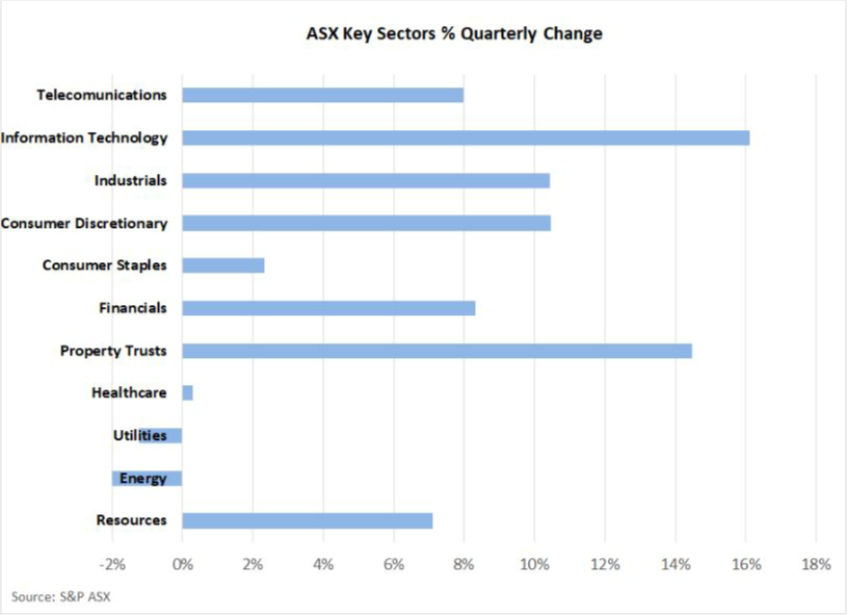
The Australian share market
outperformed the global average, with the S&P ASX 200 Index rising 7.8% over the 3 months to September.
For most of the quarter, the market
was led higher by very strong support for the banking sector. In contrast, weakening iron ore prices weighed heavily on resource stocks for much of the period before the Chinese stimulus prompted a turnaround in both
commodity prices and mining shares. The financial sector finished the quarter 8.3% higher, with resource stocks up 7.1%.
Although much smaller in size, the technology sector was the best performed on the Australian market last quarter, rising by 16.1%. The sector benefited from some positive company earnings results, with Wisetech being the standout with a 36.9% price increase.
Fixed Interest and Currenecies

The focus of bond markets over the
quarter was clearly centred on the U.S. central bank, as confirmation of lower inflation created the scope for interest rates to be cut.
With the Federal Reserve ultimately
opting for the larger 0.5% reduction in
the cash rate, interest rates were
dragged lower across the yield curve.
U.S. 10-year treasury bond yields dropped by 0.55% to 3.81%. This suggests that the money market anticipates a series of further cash rate reductions from the current level of 4.8%.
With the Australian Reserve Bank (RBA) being one of the few developed economy central banks to keep policy unchanged over recent months, there has been less movement in rates across the Australian yield curve.
None-the-less, the 10-year Australian government bond yield did fall 0.39% to 3.96% last quarter, with some evidence of lower inflation contained in the latest monthly indicator numbers for August. However, Australian labour markets remain strong, with unemployment at 4.2% removing any urgency for the RBA to cut interest rates before securing sustained lower inflation.
After declining for much of 2024, the $A appreciated against the $US last quarter, rising from US 66.2 cents to US 69.3 cents. Support for the $A was driven by the decline in interest rates in the U.S.; as well as the Chinese policy stimulus, which was viewed as being positive for Australia’s trade position. The $A was also 0.2% higher against the Euro but declined 7.9% against the Japanese Yen.
Important Information
The following indexes are used to report asset class performance: ASX S&P 200 Index, MSCI World Index ex Australia net AUD TR, MSCI World ex Australia NR Hdg AUD, FTSE EPRA/NAREIT Developed REITs Index Net TRI AUD Hedged, Bloomberg AusBond Composite 0 Yr Index, Barclays Global Aggregate ($A Hedged), Bloomberg AusBond Bank Bill Index, S&P ASX 300 A- REIT (Sector) TR Index AUD, S&P Global Infrastructure NR Index (AUD Hedged), CSI China Securities 300 TR in CN, Deutsche Borse DAX 30 Performance TR in EU. Hang Seng TR in HKD, MSCI United Kingdom TR in GBP, Nikkei 225 in JPY, S&P 500 TR in USD.
General Advice Disclaimer
This document has been prepared by Sage Advisers . Sage Advisers is a Corporate Authorized Representative of Sage Advisers Pty Ltd (AFSL 238039). Any advice provided is of a general nature and does not take into account personal circumstances. Any decision to invest in products mentioned in this document should only be made after reviewing the relevant Product Disclosure Statements. Should the reader wish to avail of using the above investment philosophy they should only do so firstly seeking personal financial advice through a financial planner. Past performance is not a reliable indicator of future
performance.


Comments